
Barber Shears vs Scissors: What Is the Real Difference?
, by Buy Barber , 14 min reading time
, by Buy Barber , 14 min reading time
Schedule a free consultation to compare barber shears vs scissors and find the professional-grade tools your shop needs for cleaner cuts and better ergonomics.
Professional barbers know that a sharp set of shears is the most important tool in their kit. Generic scissors can cut paper or fabric, but they lack the precision needed for a clean hair service. Understanding the structural differences between these two tools helps you provide better results for your clients and protect your hands during long days in the shop. Barber shears are built with convex blades, offset handles, and adjustable tension systems that household scissors simply do not offer.
Shop professional barber shears at BuyBarber , compare top brands like Andis, Wahl, and Gamma+ to find the right fit for your barber station.
Barber shears vs scissors comes down to blade geometry, handle ergonomics, and steel quality. Professional barber shears use precision-ground convex blades and VG-10 or cobalt steel alloys that slice hair cleanly. Household scissors have beveled edges and soft steel that crush the hair shaft, causing split ends. Offset and crane-handle designs in shears reduce wrist strain during all-day use, while scissors use fixed symmetrical rings. Adjustable tension screws let barbers tune blade feel, whereas household tools use fixed rivets. These differences make barber shears the only correct choice for professional hair cutting.
To many people, any tool with two blades and finger holes is just a pair of scissors. But for the professional barber, the term "shears" means something very specific. While household tools are made for paper or cloth, barber shears are engineered exclusively to cut hair. These tools use precision-ground blades that slice hair with extreme ease. Quality tools impact the result of a haircut and the comfort of the barber. When a tool is designed for a specific task, it performs better. This is why professionals do not use regular scissors for their work.
Summary: Barber shears are purpose-built tools with precision-ground blades, ergonomic handles, and adjustable tension. They date back to 1500 BC in ancient Egypt and have evolved into highly specialized instruments that protect both hair health and the barber's hands during extended use.
Tools for cutting hair have been in use for thousands of years. Early implements date back to 1500 BC in ancient Egypt, where bronze spring-loaded designs were the standard. Today we use advanced steels like 440C, VG-10, and cobalt alloys. The goal remains the same: a tool that stays sharp and moves naturally with the hand. Understanding this history helps clarify why modern shears have become so refined.
In barbering, "shears" typically refers to tools longer than 6 inches with larger finger holes and a tang rest for the pinky finger. Household scissors are shorter with smaller loops. Barber-grade shears vs home scissors comes down to whether the tool slices or crushes hair. Professional shears cut through the hair shaft cleanly, while cheap scissors compress and damage it. Most shears also feature a tension adjustment screw, while household scissors use a fixed rivet.
Here are the key ways professional barber shears differ from household scissors:
For a barber, a shear becomes an extension of the hand. It must feel balanced and operate without resistance. Because they are designed for long days in the shop, professional shears feature ergonomic shapes that reduce wrist strain. If you want to explore the full range of options, a professional hair shears guide can help you match tool features to your cutting style.
Professional barber shears and household scissors may look similar at first glance, but their construction serves fundamentally different purposes. The primary gap lies in edge quality, blade geometry, handle ergonomics, and pivot design. Each element is optimized for the demands of professional hair cutting.
Summary: Barber shears use 6.5-to-8-inch convex-ground blades with offset or crane handles and adjustable tension screws. Household scissors use shorter beveled blades, symmetrical rings, and fixed rivets. These structural differences make shears precise, comfortable, and durable for daily professional use.
| Feature | Barber Shears | Household Scissors |
|---|---|---|
| Blade Length | 6.5 to 8 inches | 4.5 to 6.5 inches |
| Handle Design | Offset or crane for neutral wrist position | Symmetrical and straight |
| Tension Control | Adjustable screw system | Fixed rivet or bolt |
| Thumb Ring | Angled or moved forward for natural thumb position | Aligned with finger ring |
| Edge Type | Convex or beveled for slicing | Flat or serrated for grip |
| Steel Grade | 440C, VG-10, or cobalt alloys | Low-grade stainless steel |
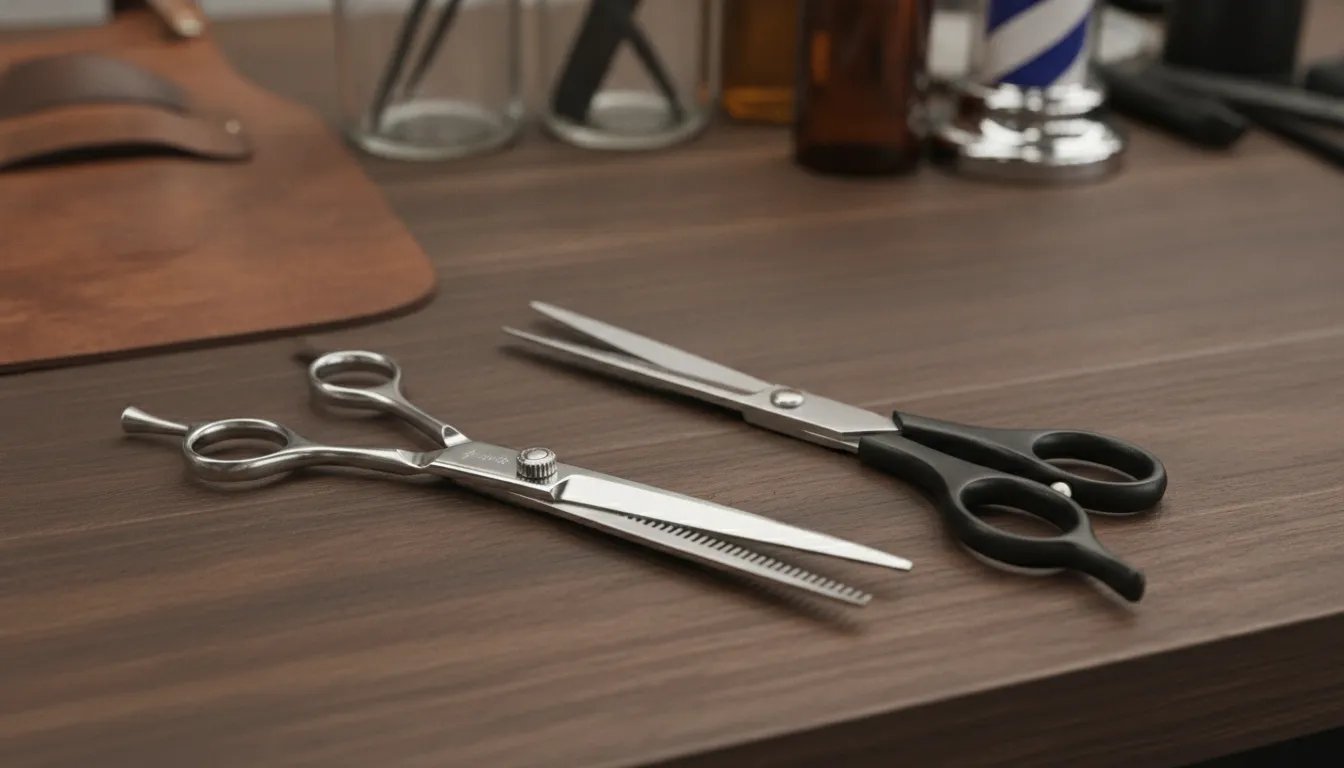
Barber shears typically measure between 6.5 and 8 inches from tip to finger ring. This extra length helps barbers execute scissor-over-comb techniques with speed and precision. Household haircutting scissors are often shorter, ranging from 4.5 to 6.5 inches, providing more control for detail work. According to ScissorTech, tools under 6 inches feel more controlled, while longer blades allow faster bulk removal.
Household scissors typically have symmetrical rings that force the wrist into an awkward position. Professional barber shears use offset or crane handles that move the thumb ring forward. This allows the hand to stay in a neutral position while cutting, reducing strain on the wrist and thumb during long workdays.
High-end shears feature a tension adjustment screw that lets the barber tighten or loosen the blades to match their cutting style. A properly adjusted precision-ground blade needs exact tension to slice hair cleanly. Household scissors use a fixed rivet that cannot be adjusted, causing them to lose cutting effectiveness much faster than professional tools.
The metal used in a pair of shears determines how long the edge stays sharp and how cleanly it cuts. Cheap household tools use low-grade steel that dulls quickly. Professional shears use high-grade alloys that maintain a sharp edge through thousands of cuts.
Summary: Professional barber shears use 440C stainless, VG-10, or cobalt steel alloys that hold a sharp edge through continuous use. These metals allow convex grinding for razor-sharp edges that slice hair instead of crushing it. Household scissors use soft steel with beveled edges that dull fast and damage the hair shaft.
Household scissors use soft metals that bend or nick easily. High-end barber tools use hardened steel blends like 440C and VG-10. Some premium models incorporate cobalt for maximum edge retention. Harder steel can be ground to a much finer edge, allowing the blade to slice through hair instead of pushing or crushing it. When exploring cast vs forged barber shears, you can see how metal choice affects tool feel and longevity.
Better steel means less frequent sharpening. A tool that holds its edge saves money and downtime. If a blade dulls quickly, it starts pulling and snagging hair. This makes the job harder and the experience less comfortable for clients. A cobalt edge keeps each cut crisp and clean.
The shape of the blade edge is another critical factor. Household scissors use a beveled edge: a flat blade with a clear angle ground into one side. Beveled edges are durable and easy to sharpen but are not as sharp as convex alternatives. Professional shears often feature a convex edge, which curves like a clamshell and comes to an extremely thin, sharp point. A convex edge is the sharpest option available for hair tools and enables slide cutting and point cutting techniques. Because the edge is so fine, it requires more careful maintenance but delivers unmatched cutting performance.
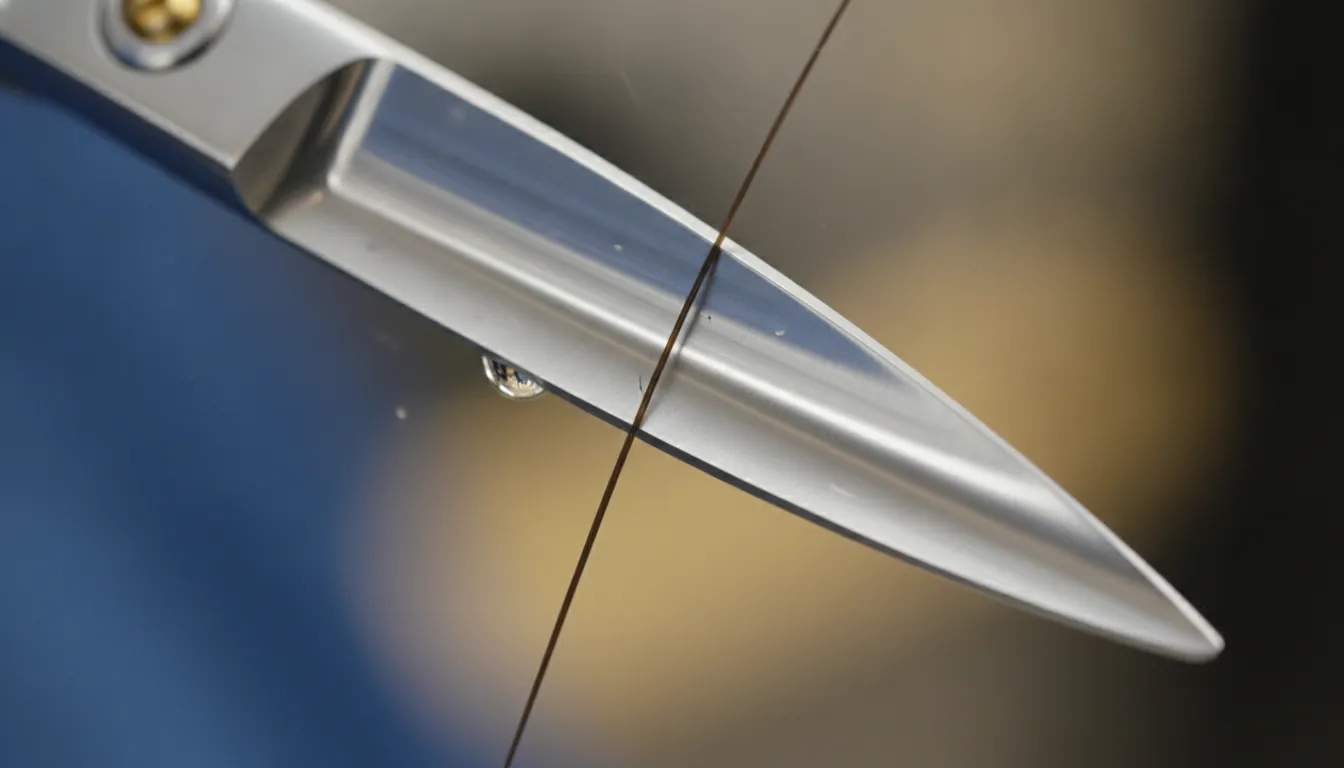
A dull blade does not cut hair -- it crushes the hair shaft until it snaps, causing split ends and frizz. Sharp, precision-ground blades slice through hair cleanly, leaving the ends smooth and healthy. A clean cut also helps the hair lay better, creating a sharper finished style. The blade angle determines how smoothly the tool moves through hair. Professional shears are built with an optimized angle that reduces the force required for each cut, saving hand energy over a full day of work.
Using the wrong tool on hair creates problems that compound over time. The gap between barber-grade shears vs home scissors is not subtle. Household scissors are designed for paper and packaging, not the delicate structure of human hair.
Summary: Household scissors crush the hair shaft instead of slicing through it because their dull beveled blades create a rough edge that frays the cuticle. This causes split ends, dryness, and frizz. The wide blade gap and heavy construction also reduce control, making precision cutting nearly impossible.
The force from dull blades bends the hair strand before cutting begins. The result is a rough, frayed edge that signals the start of damage that travels up the hair shaft. Professional tools use sharp, thin blades that slice through hair with minimal force. This is why quality tools matter in barbering so much. They create a smooth edge that preserves the hair's outer cuticle layer. Without this clean cut, hair becomes weak and prone to breaking.
Using household tools tears the outer cuticle of the hair. Once a hair splits, the damage spreads upward quickly. You may find yourself cutting off more length later to repair the damage. The crushing motion also breaks the cuticle seal, allowing moisture to escape and leaving hair dry and frizzy. A professional shear keeps the cut clean and tight, helping hair retain its natural oils and feel soft at the ends.
Scissor-over-comb blending requires a tool that stays sharp and moves with total ease. Household scissors are often bulky and heavy, lacking the fine balance needed for precision work. Their thick blades also obstruct the barber's view of the cutting line. Many professionals use the scissor-over-comb technique to achieve smooth blends, and this method demands slim, lightweight shears with unobstructed blade visibility. Professional shears provide the clear sightline and steady hand needed for exact cutting.
A professional barber uses their hands all day. Tool comfort directly affects work quality and long-term hand health. When comparing barber shears vs scissors, ergonomics is a deciding factor. A tool that fits the hand well allows longer work hours without pain.
Summary: Offset and crane handle designs reduce wrist strain by keeping the hand in a neutral position. Adjustable tension lets barbers personalize blade feel. Balanced weight distribution prevents hand fatigue. These ergonomic features make professional shears essential for barbers who cut hair for hours every day.
Household scissors have symmetrical rings that force the hand into an awkward, strained position. Professional shears use offset handles where the thumb ring sits shorter than the finger ring. This allows the hand to stay relaxed and reduces thumb movement required to close the blades. The design prevents hand cramps and keeps the wrist in a healthier position, providing more power and control with less effort.
A crane handle is a specialized offset design with a deep curve that lowers the elbow. When the elbow sits lower, stress on the shoulder and neck decreases significantly. This is especially valuable during long days in the shop. Tools without ergonomic shaping can lead to repetitive strain injuries over time. The weight distribution of professional shears is also carefully balanced from tip to handle, so the tool never feels front-heavy. This reduces grip tension and helps prevent nerve issues in the fingers.
Every barber has a different touch. Some prefer a loose blade feel while others want tight resistance. Professional shears include an adjustable tension screw that lets you customize the cutting action. According to the Florida Academy, regular oiling and tension adjustment are essential maintenance steps that keep shears performing well. Household scissors offer no such adjustability. Correct tension ensures blades glide with minimal effort, which is what separates professional gear from basic cutting tools.
If you are choosing your first professional setup, read our guide on choosing professional cutting scissors and shears for detailed selection criteria. For barbers committed to quality, the choice between barber shears vs scissors is clear: only purpose-built shears deliver the precision, comfort, and hair health that professional work demands.
Using household scissors on hair is not recommended. These tools have dull beveled blades that crush the hair shaft instead of cutting it cleanly, leading to split ends, frizz, and dryness. Professional barber shears use sharp convex edges that slice through hair, preserving the cuticle and keeping hair healthy.
Offset handles keep the wrist in a neutral position during cutting, reducing strain on the hand and forearm. The Florida Academy notes that this ergonomic design is essential for barbers who cut hair for hours daily, as it helps prevent repetitive strain injuries and hand fatigue.
Barber shears use hardened steel with convex-ground edges that catch and slice hair instantly. Household scissors push hair forward or bend it between dull blades because they lack a sufficiently sharp edge. Precision-ground blades ensure each cut is clean and smooth without pulling or folding.
Clean your shears after every use, apply a drop of oil to the pivot point, and check the tension screw to ensure blades are properly adjusted. Regular sharpening by a professional sharpener every 3 to 6 months keeps the edge in optimal condition. Proper maintenance extends the life of your shears significantly.
Most barber shears have blades between 6 and 8 inches long. This range is optimal for scissor-over-comb techniques and bulk removal. Household cutting scissors are typically 4 to 6 inches, which limits their versatility for professional barbering. Browse BuyBarber's shear collection to find the right size for your needs.
Using household scissors costs you precision, hand comfort, and hair health every day. Professional barber shears deliver cleaner cuts, protect your hands from strain, and help your clients leave with healthier hair. Making the switch is an investment in your craft and your career.
Shop professional barber shears at BuyBarber , find the perfect pair from top brands like Andis, BaBylissPRO, Gamma+, and Wahl with fast shipping and wholesale pricing.


