

Barber Spray Bottle: Mist vs Trigger Guide
, by Buy Barber , 14 min reading time
, by Buy Barber , 14 min reading time
Shop barber spray bottle designs with confidence. Compare continuous mist and trigger options for cutting, styling, comfort, capacity, and care.
A dependable barber spray bottle is not a minor station accessory; it controls how quickly and evenly you reset hair before a guideline, cross-check, or styling pass. For most cutting services, continuous mist is the best primary bottle because it lays down light, broad moisture. A trigger bottle earns its place when you need a stronger, targeted burst.
Shop professional barber spray bottles and applicators at BuyBarber.com.
The practical choice is not about which mechanism looks newer. It is about matching the spray pattern, full-bottle weight, grip, and cleaning routine to the work performed at your chair. This guide compares both designs from a barber's perspective and gives clear decision rules for cutting, styling, and workstation use. It also explains when a two-bottle setup is worth the station space and when one versatile bottle is enough.
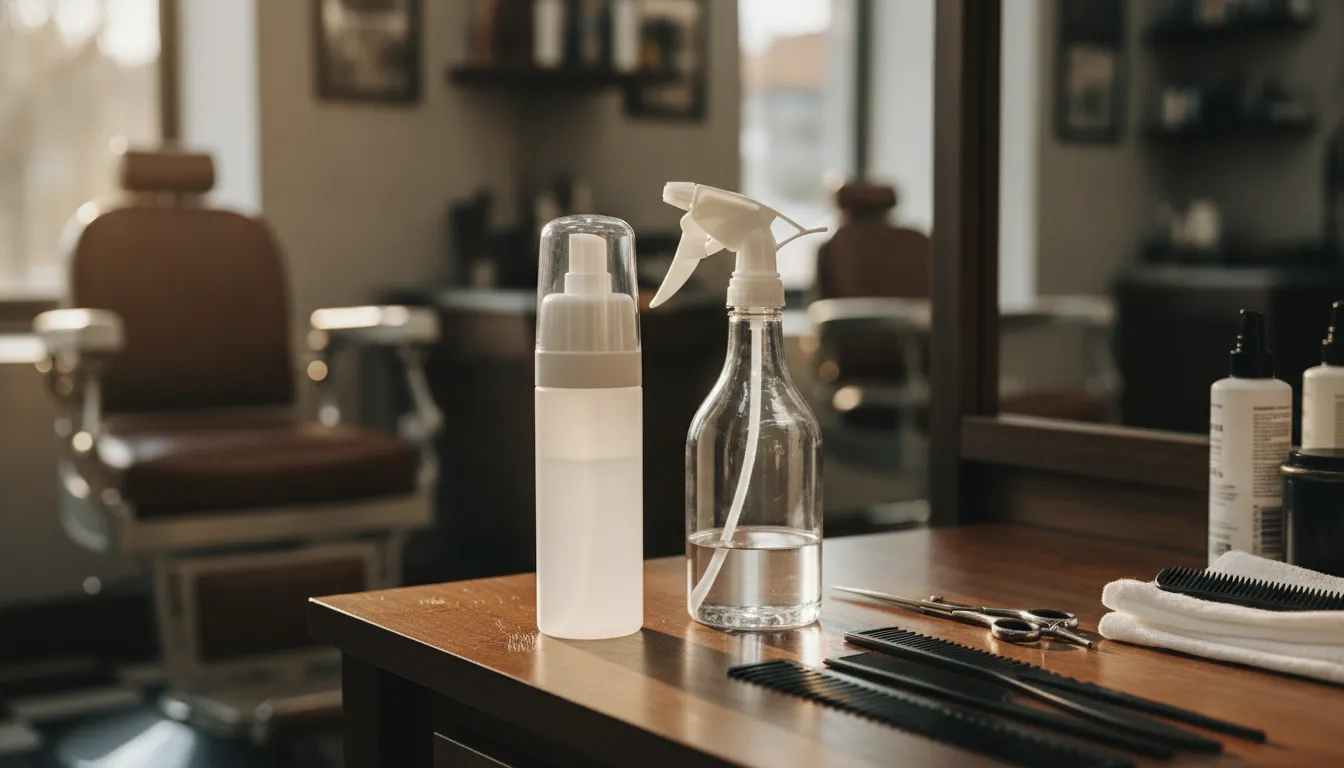
A continuous mist bottle releases a fine, broad cloud for a short period after one full lever pull, while a trigger bottle releases one stronger burst per squeeze. Choose mist for controlled, even dampening across a haircut. Choose trigger for concentrated wetting, quick saturation, or a separate workstation liquid that needs a simpler sprayer.
Continuous mist is designed to spread small droplets over a wider area. On hair, that means you can build moisture gradually instead of creating one wet patch surrounded by dry hair. It is especially useful when refreshing the top during scissor work, preparing curls for sectioning, or bringing a longer cut back to a consistent dampness before a cross-check.
A trigger sprayer sends more liquid toward a smaller target. That direct output can be useful on dense sections that resist a light mist, but it also makes over-application easier. If a client is already caped and positioned, a heavy burst near the perimeter can create runoff. A disciplined barber can use either design well; the mechanism simply changes how much control each squeeze provides.
| Decision factor | Continuous mist | Trigger spray |
|---|---|---|
| Spray pattern | Fine, broad, and gradual | Concentrated burst or stream |
| Best cutting role | Even dampening and refresh passes | Targeting a dry or dense section |
| Hand action | Fewer full lever pulls for broad coverage | One squeeze for every burst |
| Control risk | May take longer to heavily wet hair | Can oversaturate one spot quickly |
| Cleaning | Fine nozzle needs consistent flushing | Simple sprayer is often easier to rinse |
| Best station role | Primary cutting-water bottle | Backup, targeted wetting, or compatible workstation liquid |
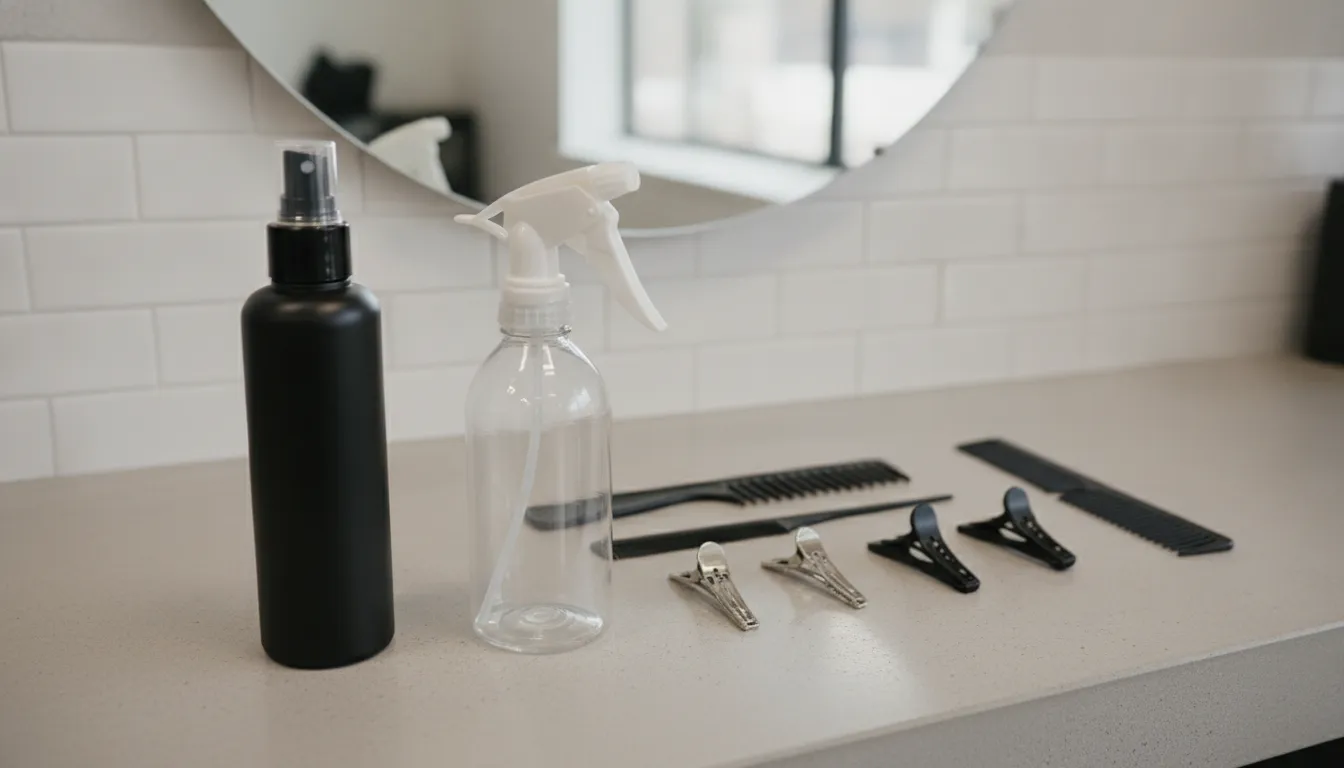
Do not assume every mist bottle sprays upside down or every trigger head adjusts from stream to spray. Those are model-specific features. Read the product details, then test the actual pattern with clean water before placing a new bottle into client service.
For most cutting and styling work, use a continuous mist bottle as the primary water bottle and keep a trigger bottle available for targeted wetting. Mist gives the barber more time to judge moisture as it builds. Trigger output is useful when thick, coarse, or very dry sections need a deliberate burst before combing or sectioning.
Consistency matters more than maximum output during a wet cut. If one panel is saturated and the next is only lightly damp, tension and fall can change as you move around the head. A fine mist helps restore moisture across multiple panels without restarting the service with dripping-wet hair. Spray from a practical distance, comb the moisture through, and reassess before adding more.
For short cuts, do not automatically mist the entire head. Use the bottle where moisture improves control, such as a stubborn crown, longer top, or fringe. Keeping the sides drier can preserve visibility during clipper work. This service-by-service thinking is more useful than declaring one bottle ideal for every technique.
When styling, light moisture can reactivate hair and make product distribution more manageable. Continuous mist is useful because the application can stop before the finish collapses. On dense or highly absorbent hair, however, a direct trigger burst into the section followed by combing may be faster. The right choice is the one that reaches the intended moisture level with the fewest corrections.
A practical two-bottle setup works well for a busy barber: one clearly labeled mist bottle containing clean water for hair, plus one separate trigger or approved applicator for another compatible station task. Never rely on memory to distinguish identical bottles. Labels reduce mistakes, and dedicated bottles keep the cutting-water bottle simple to maintain.
Choose capacity by balancing refill frequency against full-bottle weight. A larger bottle is not automatically better if it feels awkward late in a shift. The most practical design fits your grip, operates without pinching, remains stable on the station, and holds enough water for your normal block of appointments without unnecessary bulk.
An empty bottle can feel perfect in a product photo or in your hand, then become top-heavy once filled. Before adopting one for daily use, fill it to the intended level and simulate your normal motions: pick it up from the station, mist the top, reach around the opposite side, and set it down. Check whether the base stays stable and whether your wrist must bend sharply to operate the lever.
Grip diameter also matters. A narrow bottle may suit smaller hands but feel less secure in larger hands. A broad lever lets multiple fingers share the pull, while a short trigger concentrates the action. There is no universal best grip, so judge the tool after several realistic repetitions rather than one squeeze.
Think about the rest of your professional barber kit as one working system. A bottle that crowds clipper guards, combs, and hot tools is not efficient, even if it holds more water. Match its footprint to the space you actually have.
The most controllable spray pattern is the one that reaches the intended section without forcing a correction. Fine mist wins for broad, progressive dampening because you can stop before hair becomes saturated. A direct trigger burst wins for one resistant section. Test width, droplet size, and output at the distance you normally work.
Terms such as fine mist, continuous spray, and adjustable nozzle describe general behavior, but two products in the same category can perform differently. Fill the bottle with clean water and spray onto a dry towel or dark cape from a consistent distance. A good mist pattern should look even rather than producing a heavy center spot. A useful trigger pattern should land where aimed without unpredictable side spray.
Then test on hair during an appropriate service. Watch whether moisture sits on the outer layer or reaches the section after combing. If you repeatedly need extra passes, the bottle may be too fine for that role. If you repeatedly blot runoff, the output is too concentrated or your working distance is too close.
Use mist for broad top sections, longer layers, curl refreshing, and maintaining consistent dampness during cross-checking. Use a trigger burst for a single dry area, a dense section that needs more water, or rapid wetting before reparting. A barber who switches intelligently between patterns gains more control than one who forces a favorite bottle into every service.
Compare spray bottles and applicators for your cutting and styling workflow.
Keep the hair-water bottle dedicated to clean water, clearly label every other bottle, and separate tools by task. The bottle used to dampen a client's hair should not be confused with a workstation bottle. Clear labels, distinct colors or shapes, and a fixed station location make the correct choice obvious during a fast turnaround.
A well-organized station saves movements and prevents bottle mix-ups. Give the cutting-water bottle a consistent home within easy reach but away from cords and hot tools. Put other applicators in a different zone and use labels that remain readable when wet. If two bottles look identical, add a second visual cue such as a different colored label or sprayer head.
Keep the station uncluttered enough that the bottle can be picked up and returned without shifting other tools. The same principle applies to combs, guards, and finishing products. See BuyBarber's guide to organizing a barber station for a broader workflow approach.
Do not pour a liquid into a bottle simply because it can be poured. Fine mist mechanisms can struggle with thick, oily, salty, or particle-heavy formulas. Check the formula instructions and the bottle maker's compatibility guidance. If compatibility is unclear, keep that liquid in its original packaging or use an applicator designed for it.
A dedicated water bottle is the easiest setup to troubleshoot. If its spray weakens, you know the issue is likely the nozzle, water deposits, or wear rather than an unknown formula. Separating tasks also makes daily cleanup faster and keeps the primary cutting tool ready for the next service.
Maintain a barber spray bottle by emptying old contents, rinsing the reservoir, and flushing clean water through the sprayer before residue affects the pattern. Follow the maker's care directions, especially for non-water liquids. Replace the bottle when it leaks, cracks, smells unusual, sticks, or produces an inconsistent spray after cleaning.
At the end of the working period, check the bottle exterior, cap, pickup tube, and nozzle. Wipe away hair and product residue from the outside. Refresh the water based on your shop's normal procedures, then run clean water through the mechanism so residue does not dry in the spray path. Leave components to dry only when the design and maker instructions allow it.
For a deeper clean, follow the product instructions rather than improvising with harsh cleaners or very hot water. Materials and seals differ between models. If the bottle contained anything beyond water, use the cleaning process recommended for that formula and sprayer. Never mix leftover liquids or top off an unlabeled bottle.
Keep replacement timing practical. A cheap, unreliable sprayer can interrupt sectioning, wet the client unexpectedly, and slow every appointment. Include bottles in routine station checks alongside the other essential barber tools that directly affect service flow.
For the strongest all-around setup, buy a comfortable continuous mist bottle for cutting water and add a clearly differentiated trigger bottle only when a real task calls for concentrated output. Select each bottle by service role, filled weight, spray test, station footprint, formula compatibility, and ease of cleaning rather than appearance alone.
If you are building or refreshing a complete setup, review this barber spray bottle collection and the broader guide to barber kit essentials. The best purchase is not necessarily the largest or most elaborate bottle. It is the one that makes your most common service easier every time you reach for it.
Most barber spray bottle questions come down to four practical issues: which mechanism suits daily cutting, how much capacity is comfortable, what liquids are compatible, and how often the sprayer needs care. The answers below provide fast rules, but the product maker's instructions should always guide compatibility, cleaning, and operation for a specific model.
A continuous mist bottle is the better primary choice for most barbers because it dampens hair evenly with fewer lever pulls. A trigger bottle is better when you need a fast, concentrated burst on one section or a separate bottle for workstation tasks.
Choose a bottle that holds enough water for your normal service block without becoming tiring when full. For most stations, a balanced medium-capacity bottle is more practical than the largest option. High-volume barbers can keep a filled backup rather than carrying extra weight through every service.
Only use a liquid if the bottle maker says the sprayer is compatible with it. Thick, oily, salty, or particle-heavy formulas can clog a fine mist nozzle. Keep plain water in your cutting bottle and use a clearly labeled, compatible applicator for other products.
Empty and rinse a water bottle regularly, then flush clean water through the nozzle whenever the pattern weakens or shifts. Clean product applicators according to their formula and maker instructions. Replace a bottle that leaks, cracks, develops an odor, or no longer produces a dependable pattern.
For most professionals, the smartest final choice is a continuous mist bottle for routine hair dampening, supported by a trigger bottle when concentrated output serves a clear purpose. Buy for the work at your chair, keep every bottle labeled, and maintain the spray path before performance slips.
Shop barber spray bottles and applicators at wholesale prices from BuyBarber.com.


