

How to Choose a Barber Chair for a Professional Shop
, by Buy Barber , 13 min reading time
, by Buy Barber , 13 min reading time
Learn how to choose a barber chair for a professional shop by comparing construction, hydraulics, padding, recline, footprint, comfort, and maintenance.
Choosing a barber chair for a professional shop is not only a matter of matching the decor. The chair affects how comfortably clients sit, how easily you can work from different angles, how smoothly the shop runs, and how simple daily cleaning becomes. Before comparing finishes or styles, evaluate the frame, base, hydraulic function, padding, recline, footprint, and service requirements that will matter on every appointment.
Browse professional barber supplies at BuyBarber
A professional barber chair should provide stable support, dependable height adjustment, comfortable padding, a working recline position when your services require it, and a surface that can be cleaned according to product-label directions. It should also fit the station footprint and leave enough room for safe movement around the client.
That definition gives you a better starting point than choosing by appearance alone. A chair can look impressive in a showroom and still be a poor fit if the pump slowly sinks, the footrest blocks your stance, the seat is too narrow for your clientele, or the upholstery is difficult to maintain.
Use these criteria to create a short list. Then test the actual chair or request complete specifications from the supplier before placing a multi-chair order.
Construction determines how a barber chair responds to repeated movement, client transfers, daily cleaning, and the working habits of the barber. Focus on how the frame, seat support, armrests, backrest, base, swivel, footrest, and fasteners work together instead of judging one material in isolation.
Start with stability. With the chair in its normal working position, check whether the base sits flat and whether the frame shifts when a client sits down or leans back. A slight movement in a display model can become frustrating when repeated throughout a full schedule. Ask how the chair is anchored, how replacement hardware is sourced, and what service process applies if a moving part needs attention.
Look closely at the points that receive the most contact:
Do not assume that a heavier chair is automatically better. The useful question is whether the construction supports the chair's intended use, service range, and maintenance plan. Request the manufacturer's rated capacity, installation requirements, warranty terms, and replacement-part availability rather than filling in missing specifications yourself.
The hydraulic lift controls working height, so it influences both barber posture and client access. The best choice for your shop is a lift that moves smoothly, holds its selected height, and has controls that can be reached without awkwardly stepping away from the station.
Test the chair through its full available range. Listen for unusual sounds, check for hesitation, and confirm that the seat does not drift downward under normal use. If you are evaluating a chair in a showroom, ask whether the displayed unit has been adjusted or serviced and whether the same pump is used in the production model.
Ask the supplier these practical questions:
A chair that holds a comfortable working height reduces the need to bend, reach, or work around a client at an awkward angle. For a shop with several stations, consistent lift behavior also makes it easier for different barbers to settle into a repeatable workflow.
Padding and upholstery should support client comfort while standing up to repeated contact with hair, product residue, moisture, and approved cleaning products. Evaluate the seat, backrest, headrest, and armrest surfaces together, then ask how the cover should be cleaned and what products could damage it.
Have someone sit in the chair for several minutes rather than judging it with a quick hand press. Check whether the seat supports the hips and thighs, whether the backrest keeps the client centered, and whether the armrests feel stable. A comfortable chair should not force every client into one posture if your shop serves different body types.
Inspect the cover for straight seams, secure edges, and surfaces that can be wiped without leaving hard-to-reach folds. Confirm whether replacement covers or upholstery service are available. A small tear can spread faster when it is near a seam or high-contact edge, so repair options are part of the buying decision.
Cleaning instructions matter as much as the material name. The CDC guidance for beauty salons and barbershops recommends cleaning and disinfecting styling chairs and other frequently touched items between clients, while following the label directions for dilution and contact time. Review the CDC guidance for salon and barbershop employees, then confirm that your chosen chair cover is compatible with the products and routine used in your shop.
A reclining barber chair is most useful when your service menu includes straight-razor shaves, hot towel services, beard work, facials, or other treatments that benefit from a supported reclined position. If the shop primarily performs quick cuts, a simpler chair may satisfy the workflow without adding functions you rarely use.
Test the recline before buying. The release should be easy for the barber to operate, the backrest should move in a controlled way, and the chair should remain stable at each working position. Check whether the headrest adjusts enough to support the client's head during the services you offer. Also make sure the reclined chair does not collide with the mirror, station, wall, or another chair.
Ask whether the recline mechanism locks securely and whether the supplier provides service guidance for the hardware. Avoid choosing a chair solely because it reclines if the added mechanism makes cleaning, repairs, or station access harder. The right feature is the one that improves a real service in your shop.
The published chair dimensions are only one part of the footprint. You also need space for a barber to stand and move, a client to approach and leave, a footrest or reclined backrest to extend, and doors, drawers, cords, and cleaning equipment to remain accessible.
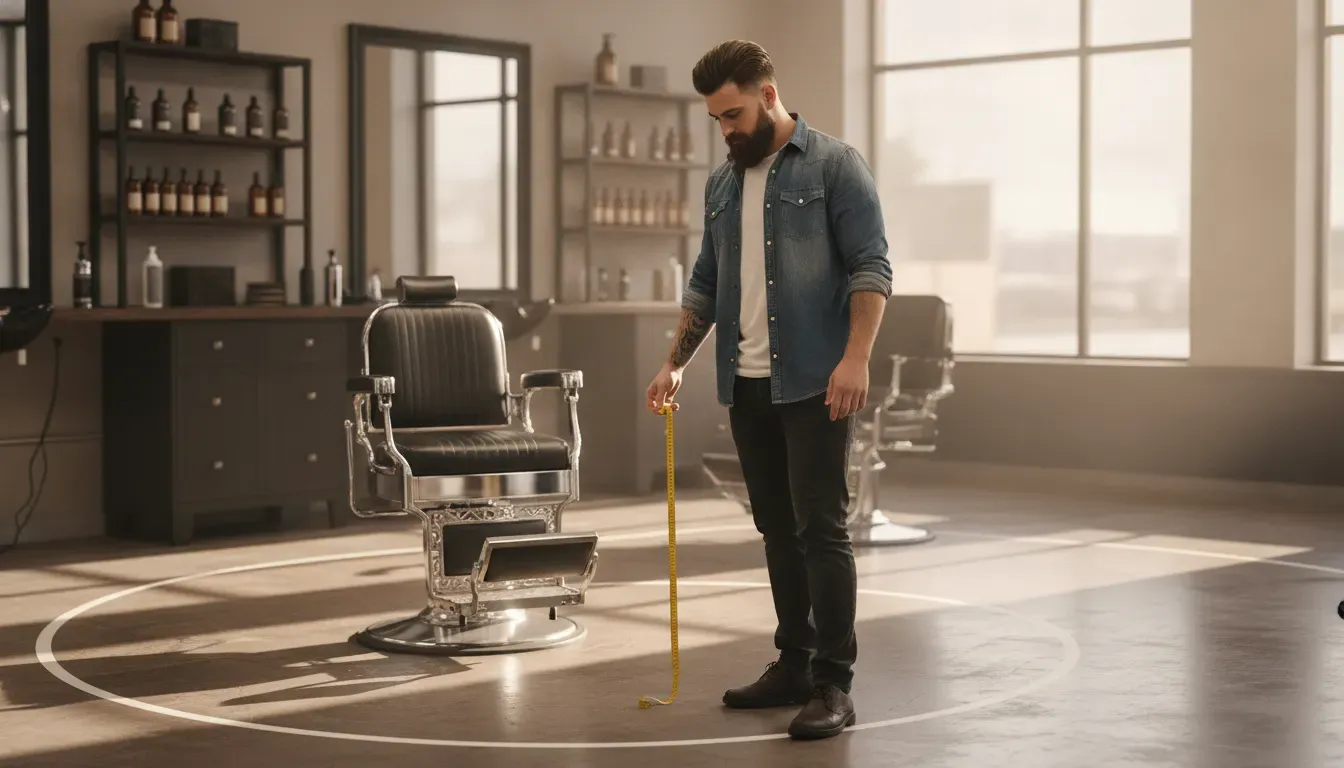
Measure the full station before ordering. Mark the chair base, the furthest reclined position, the front edge of the footrest, and the normal barber work zone on the floor. Repeat the exercise for an occupied chair if possible. This reveals conflicts that are easy to miss when looking at a product listing.
| Footprint check | What to confirm before ordering |
|---|---|
| Chair width | Armrests and client access do not interfere with adjacent stations. |
| Working depth | The barber can stand and move without blocking a doorway or service path. |
| Recline clearance | The backrest and headrest can move without touching walls, mirrors, or equipment. |
| Base and pedal | The hydraulic control remains reachable and does not become a trip point. |
| Cleaning access | Staff can reach around the base and underneath the chair for routine cleaning. |
For broader station planning, see BuyBarber's barber shop layout guide. The chair decision should support that larger workflow rather than forcing the shop to rebuild its traffic path after delivery.
Client comfort and barber ergonomics are connected. The client needs stable support and a position that suits the service, while the barber needs enough access to work around the head, neck, shoulders, and face without repeatedly twisting or reaching.
Run a realistic test before committing. Sit in the chair, adjust it to a working height, recline it if applicable, and simulate the movements required by a haircut and beard service. Check whether the armrests, headrest, and footrest help or interfere. If more than one barber will use the chair, invite them to test it because body height and technique change the fit.
Consider these questions:
Do not confuse softness with comfort. A very soft seat can feel good briefly but may not provide the support clients need during a longer appointment. Balance cushioning with posture, stability, and ease of movement.
Maintenance starts before the chair arrives. Choose a model with clear cleaning instructions, accessible moving parts, available replacement components, and warranty support that your team can realistically use. A maintenance plan protects the investment and helps prevent a small pump, swivel, or upholstery problem from disrupting appointments.
Build a simple routine around the manufacturer's instructions:
Never improvise with a chemical or lubricant just because it is available at the station. The wrong product can damage upholstery, finishes, seals, or moving components. Keep the chair's care instructions where the team can find them and include chair checks in the same operational routine as tool cleaning and station reset.
Shop professional barber equipment and supplies for your next station upgrade
Before you place an order, ask for the information that affects fit, installation, service, and long-term use. A supplier should be able to explain the chair's intended use and provide the documentation needed for your team to operate and maintain it safely.
For opening or remodeling projects, combine this chair review with a broader barbershop equipment checklist. That keeps the chair purchase connected to mirrors, storage, sanitation supplies, tools, and the rest of the station instead of treating it as a standalone decor purchase.
Use this final checklist to compare models consistently. It is more useful than relying on a product photo because it turns the purchase into a documented fit test for your shop, your service menu, and your maintenance routine.
| Decision area | Pass the chair if you can confirm |
|---|---|
| Construction | The frame, base, swivel, armrests, and footrest feel stable during normal use. |
| Hydraulics | The chair adjusts smoothly and holds its working height without unexplained sinking. |
| Comfort | The seat, backrest, and headrest support a range of clients during the shop's services. |
| Recline | The range and lock position serve the menu without creating clearance problems. |
| Footprint | The full working and cleaning zones fit the planned station. |
| Maintenance | Cleaning instructions, service parts, and warranty contacts are clear. |
| Shop fit | The chair supports the workflow, client experience, and staffing model. |
When two chairs appear similar, choose the one with clearer documentation, better service support, and a stronger fit for the way your team actually works. Those details are more valuable than a finish that only looks good in a product photo.
Stability and dependable adjustment are the most important starting points. A chair should remain steady, support the client, and hold a useful working height. From there, choose recline, padding, upholstery, and accessories based on the shop's service menu and maintenance plan.
No. Recline is especially useful for straight-razor shaves, hot towel services, facials, and beard work. A shop that mainly performs upright cuts may prefer a simpler chair if it provides better stability, comfort, access, and service support.
Measure the chair's full width and depth, then account for the barber's working zone, client access, footrest, recline clearance, nearby stations, and cleaning access. Mark the footprint on the floor before ordering and compare it with the supplier's complete assembled dimensions.
Follow the chair manufacturer's care instructions and the cleaning product label. Remove visible hair and residue, then clean and disinfect frequently touched surfaces according to the required contact time. Confirm that the products used by your shop are compatible with the upholstery and hardware.
Ask for complete dimensions, capacity, adjustment and recline ranges, approved cleaning methods, installation requirements, warranty coverage, replacement-part availability, and the process for damaged deliveries or service. Written answers make chair comparisons easier and reduce surprises after installation.


